
Article: The Complete Guide to the North American Patio Heater Industry
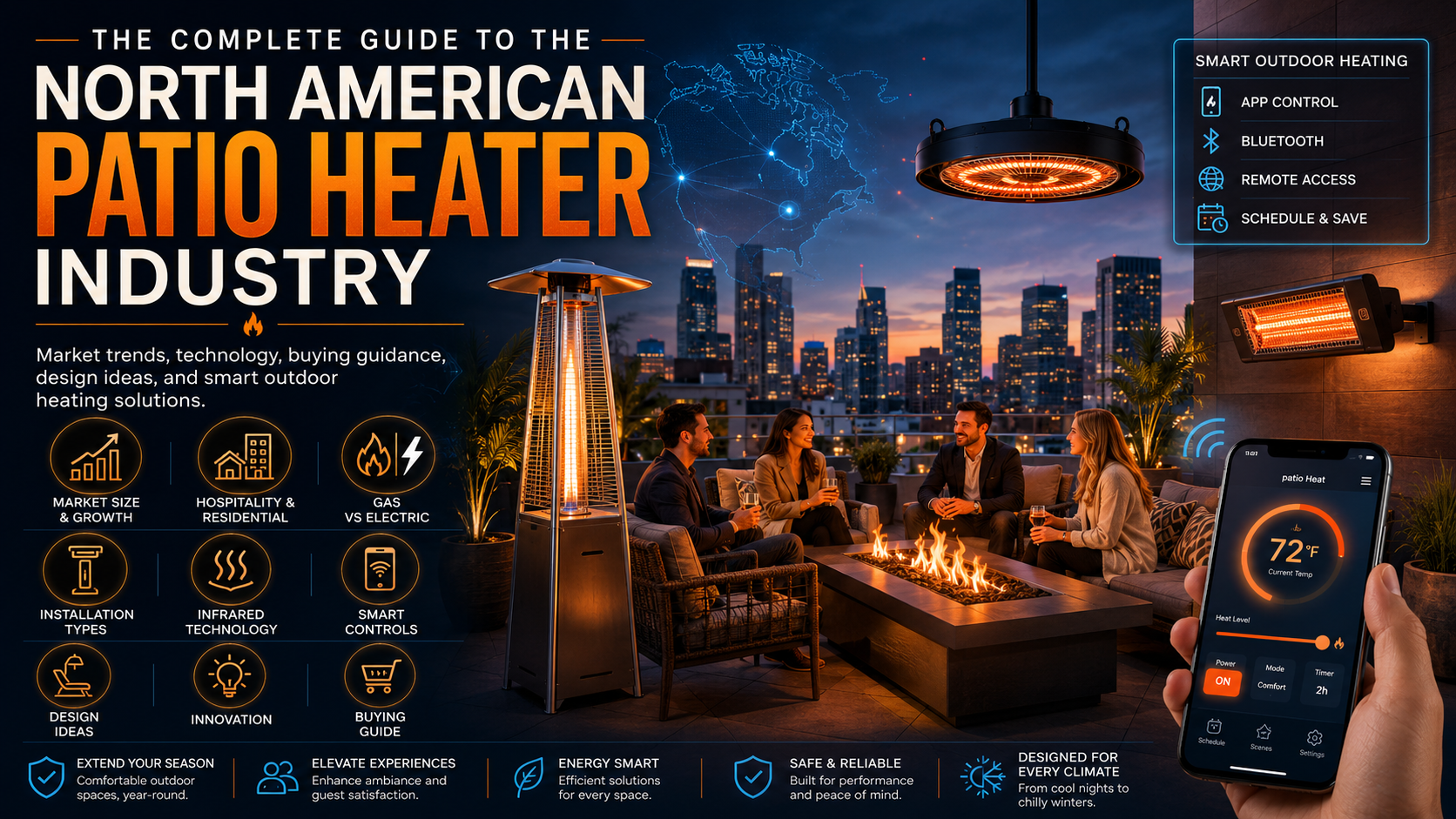
The Complete Guide to the North American Patio Heater Industry
INDUSTRY REPORT · PATIOHEATDIRECT.COM
Market, technology, brands, costs, and how to choose the right heater — everything a prospective buyer, designer, or restaurant operator needs in one place.
If you're researching patio heaters — for a backyard, a restaurant patio, a hotel entrance, a cabana bar, or a full hospitality build-out — this guide is meant to be the single most useful document you'll find on the subject. We cover the market itself, the technology, the major players, gas vs. electric, mounting styles, smart controls, realistic cost and installation ranges, sizing, design ideas, and safety. Everything here reflects both industry research and hands-on experience selling, installing, and living with these heaters ourselves.
SECTION 1
The Market: Outdoor Heating Is a Growth Industry
Outdoor heating went from niche to mainstream in a single decade, and North America is the engine of that growth. A few data points from the major research houses paint a consistent picture:
The exact figures vary by how each firm defines the category — The Business Research Company sizes the wider outdoor heating market at roughly US$4.2 billion in 2025, headed toward US$5.6 billion by 2030 — but the direction is unanimous: mid-to-high single-digit growth for years to come, with the United States and Canada leading.
What's driving it
The outdoor living boom. Patios, decks, pergolas, cabanas, and outdoor kitchens are now treated as genuine extensions of the home. Homeowners who invest $50K–$250K in an outdoor space aren't going to abandon it for six months a year. A heating system is what converts a three-month asset into a nine-month asset.
The permanent shift in hospitality. The pandemic forced restaurants to build serious patio programs, and diners never went back. Patio capacity is now revenue capacity, and every operator learned the same lesson: a heated patio in October and April is pure incremental sales. Catering and hospitality remains the leading application segment in most market studies.
Electrification and efficiency trends. Environmental regulation and energy-cost awareness are pushing innovation toward efficient infrared technology (which heats people and objects, not air) and toward electric radiant products in jurisdictions moving away from gas.
Smart controls. Wireless controls, two-stage burners, remotes, and zone systems are turning heaters from dumb appliances into managed building systems — a trend we cover in Section 8.
SECTION 2
Market Breakdown: Who's Buying, and What Are They Buying?
The North American market splits into three broad demand segments:
Hospitality and food service — the largest commercial segment
Restaurants, bars, breweries, hotels, resorts, golf clubs, casinos, and event venues. This is the most demanding segment — heaters run every night for hours, in weather, often in coastal or winter climates. It's also where the premium brands dominate, because commodity heaters simply don't survive nightly commercial duty. The industry's most recognizable installs are hospitality: IR Energy heaters at the Wynn and Encore in Las Vegas, Four Seasons, and Ritz-Carlton properties; Schwank heaters across chains like Chili's, Buffalo Wild Wings, Hooters, and numerous Whole Foods locations. When guest comfort is revenue, operators buy commercial-grade.
Residential — the fastest-growing segment
Homeowners heating patios, pool decks, pergolas, cabanas, outdoor kitchens, and covered porches. This segment splits sharply in two:
- Commodity buyers — big-box mushroom heaters in the $150–$500 range, typically lasting one to three seasons.
- Premium buyers — homeowners who've been through a commodity heater or two, or who are finishing a serious outdoor renovation and want equipment that matches the investment. This buyer purchases the same commercial-grade product the Wynn buys, and it lasts a decade or more.
Commercial/institutional and industrial
Transit shelters, stadiums, arenas, smoking areas, loading docks, warehouses, garages, agricultural buildings, and workshops. Overhead gas tube heaters dominate here — including vented models for enclosed and semi-enclosed spaces. (If you're heating a garage or shop, see our Schwank tube heater lineup, which runs from compact 10-foot U-tube units up to 60-foot industrial configurations.)
CHANNEL TREND
Distribution is shifting steadily online, particularly for premium equipment where buyers research heavily before purchasing. That's precisely the gap Patio Heat Direct was built to fill: direct-ship distribution of commercial-grade IR Energy and Schwank product across the USA and Canada, with real product knowledge behind it — read more on our About and Why Choose Us pages.
SECTION 3
The Players: Who Makes Patio Heaters?
The competitive landscape has three tiers.
Tier 1 — Premium commercial-grade infrared specialists
These are engineering companies first, heater companies second. They build for hospitality duty cycles, use marine-grade materials, publish real spec sheets, and stand behind multi-year warranties with actual parts availability.
- Schwank (Cologne, Germany; North American manufacturing in the USA and Canada) — the inventor of gas infrared heating. Family-owned since the 1930s, operating in over 40 countries. Full profile in Section 10.
- IR Energy (Stoney Creek, Ontario, Canada) — the luxury patio heater specialist behind the evenGLO, evenTUBE, Habanero, and eWAVE lines, found at some of the most prestigious hotels and resorts on the continent. Full profile in Section 9.
- Bromic (Australia) — design-forward gas and electric radiant heaters, strong in the architectural/design channel.
- Infratech (USA) — electric quartz radiant heaters, popular in design-build residential projects.
- Calcana (Canada) — gas tube heaters for patio and industrial applications.
- Sunpak / AEI Corporation (USA) — overhead gas heaters, a longtime hospitality staple.
Tier 2 — Mid-market and specialty
Lava Heat Italia (statement-piece tower heaters), Napoleon (broad outdoor living portfolio), Lynx (outdoor kitchen ecosystem), Crown Verity (Canadian commercial outdoor equipment), Tansun and Solaira (electric radiant).
Tier 3 — Commodity/import
AZ Patio Heaters, Fire Sense, Hampton Bay, and a long tail of import brands sold through big-box and marketplace channels. These serve a real purpose — low-cost, occasional-use heating — but they're built to a price point, not a duty cycle. Thin-gauge steel, painted finishes that rust, plastic ignitors, and no meaningful parts support. If you've owned a mushroom heater that died after two winters, it came from this tier.
OUR POSITION, STATED PLAINLY
Patio Heat Direct specializes in Tier 1, and specifically in IR Energy and Schwank equipment, because after evaluating the field we concluded these two brands offer the best combination of build quality, heat performance, longevity, parts availability, and warranty support in North America — one Canadian-made, one German-engineered and US/Canadian-built. We put our name behind them because we use them ourselves.
SECTION 4
The Main Categories of Equipment
Nearly everything in the market falls into one of these families:
1. Portable freestanding "mushroom" heaters
The classic silhouette: a post, a burner, and an overhead reflector dome, usually propane-fired with the tank hidden in the base. Portability is the killer feature — roll it where you need it, store it off-season. Quality varies enormously; the premium version of this format is the IR Energy evenGLO GA201M2 (46,000 BTU, commercial and marine-grade stainless steel), which carries the industry's largest top reflector and roughly 58% more heat coverage than typical competitors — a warm circle 20–24 feet across.
2. Fixed post-mount (permanent) heaters
The same overhead-reflector concept, but bolted to the deck and plumbed to natural gas — no tanks, no refills, ever. Examples: the evenGLO GA301U fixed post mount (53,000 BTU, NG) and the fixed hanging GA301H for suspended installations.
3. Overhead tube heaters (low-intensity infrared)
Long, slim radiant tubes mounted to a ceiling, pergola, or wall — the workhorses of restaurant patios and the sleekest way to heat a covered space without consuming any floor area. Available non-vented for outdoor use (like the IR Energy evenTUBE Slimline ETS series, 9' to 17' lengths, 38,500–100,000 BTU, CSA-approved for rain, wind, or shine) and vented for enclosed or semi-enclosed spaces — screened porches, garages, tents, enclosed patios (the evenTUBE Vented ETSV series). Schwank's tube range extends this deep into commercial and industrial territory, from the 10' compactSchwank P40 U-tube (a garage favorite) through comfortSchwank two-stage outdoor tubes up to 60-foot, 200,000 BTU configurations.
4. High-intensity wall/ceiling-mount gas heaters (ceramic emitters)
Compact overhead boxes with glowing ceramic tile emitters that deliver intense, focused radiant heat — the "instant sunshine" category, and the go-to for open-front patios, hotel entrances, and high-ceiling spaces. The two benchmark products here are The Habanero by IR Energy (20,000–50,000 BTU, dual-stage, named after one of the world's hottest peppers for a reason) and the supremeSchwank with its patented ceramic tile design, quick ramp-up, and marine-grade stainless construction.
5. Electric infrared radiant heaters
Slim wall/ceiling-mount panels using quartz elements or long-wave emitters. Zero combustion, zero emissions at point of use, zero clearance-to-gas concerns, and legal in places gas isn't. The main families: IR Energy eWAVE medium wave (visible warm glow, remote-control models available) and eWAVE long wave (virtually no light — pure invisible heat); electricSchwank medium-wave quartz single/dual-bulb units in stainless steel; the eSchwank Ghost Series (up to 6,000W, remote included, low-glare); and the eSchwank Titan Series — high-intensity short-wave, 6kW/12kW, IP65 marine-grade, 3-phase, mountable up to 20 feet for serious commercial spaces.
6. Tabletop, fire pits, and decorative fire features
Fire tables, chimineas, and small tabletop units. Beautiful ambiance; modest heat. These are ambiance-first products — a fire table makes a patio feel warm; an infrared heater makes it be warm. Many of the best patios use both.
SECTION 5
How to Choose: Gas vs. Electric
The single most common question we get. Here's the honest framework.
Choose GAS (natural gas or propane) when:
- You need maximum heat output. Gas heaters deliver 20,000–100,000+ BTU per unit; electric units top out around 6,000W (~20,500 BTU equivalent). For large open patios, cold climates, and windy exposures, gas wins on raw power.
- You have (or can run) a natural gas line. NG is the lowest-cost fuel per BTU in most of North America and eliminates tank swaps forever.
- You want portability. Propane mushroom heaters are the only truly portable high-output option — no cords, no plumbing.
- You're heating fully open or high-ceiling spaces, where electric's more focused throw would need many units.
Trade-offs: gas requires clearances, proper ventilation considerations (non-vented outdoor units must be outdoors or in sufficiently open structures; enclosed spaces need vented models), annual maintenance, and professional installation for fixed units.
Choose ELECTRIC when:
- The space is covered, enclosed, or semi-enclosed — under a low pergola, a screened porch, a covered balcony, or indoors. Electric has the lowest clearance-to-combustibles in the industry and no combustion byproducts.
- Gas isn't available or isn't permitted. Condos, balconies, some municipalities, and many indoor applications.
- You want zero maintenance and instant on/off. No pilot, no burner, no annual service. Flip a switch (or press a remote) and you have heat in seconds.
- You value quiet, clean design. Long-wave electric units like the eWAVE Long Wave series emit essentially no light — pure heat with no glow, ideal above dining tables and in living-room-style outdoor spaces.
Trade-offs: electric needs dedicated circuits (240V for anything serious), output per unit is lower, and operating cost per BTU is usually higher than natural gas (though electric is more efficient at converting energy to targeted radiant heat, which narrows the real-world gap).
THE PRACTICAL ANSWER FOR MOST PROJECTS
Many of the best installations mix both: gas tube or ceramic heaters for the big open zones, electric radiant for covered nooks, bar overhangs, and spots close to combustibles. If you want help mapping this to your actual space, contact us — layout advice is free.
SECTION 6
How to Choose: Freestanding vs. Fixed vs. Overhead
Freestanding portable — Maximum flexibility, zero installation. Best for: homeowners who entertain in different zones, renters, seasonal setups, restaurants that reconfigure. The premium pick is the evenGLO portable, available in propane or easy-connect natural gas.
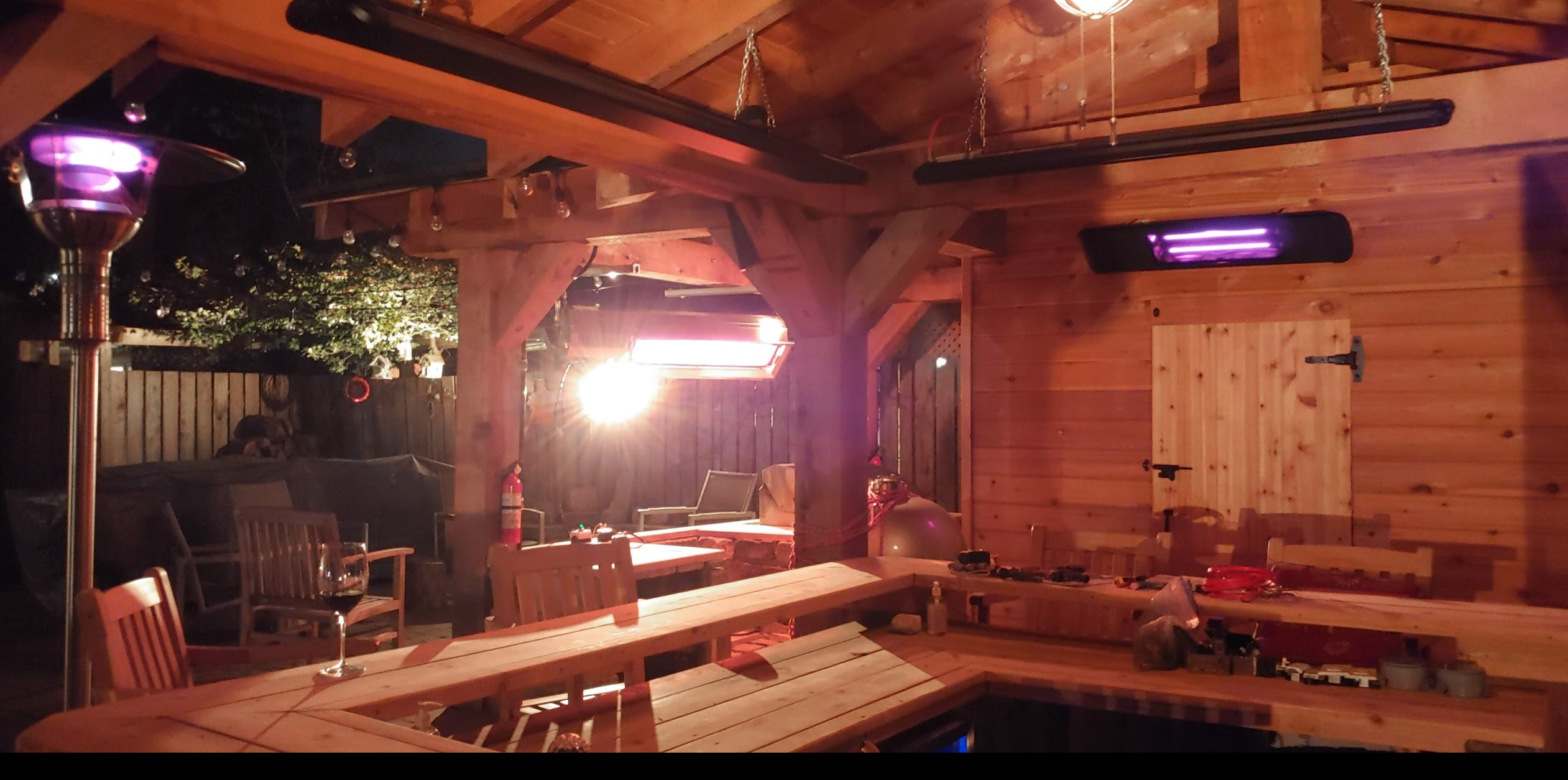
Fixed post-mount — The permanent version of the mushroom heater: bolted down, hard-plumbed to NG, always ready, nothing to store, nothing to steal, no tanks. Best for: defined seating areas you'll heat for the next decade. This is what we run at Dave's own cabana bar.
Overhead (wall/ceiling/hanging) — The professional's choice wherever there's structure above: pergolas, covered patios, awnings, entrances. Overhead heaters free 100% of your floor space, heat evenly from above the way the sun does, can't be knocked over, and disappear visually. Tube heaters (evenTUBE, phantomSchwank) suit long, linear coverage; high-intensity ceramic boxes (Habanero, supremeSchwank) suit focused zones and higher mounting; slim electric panels suit tight clearances.
A note on hanging installs: with the right hardware, overhead units can also be chain-suspended for unusual ceiling situations — we wrote up a practical example in Alternative Mounting Solutions using Chains for eWAVE heaters.
SECTION 7
The Technology: Why Infrared Wins Outdoors
Here's the physics in one paragraph: convection heaters warm air, and outdoors, warm air leaves immediately. Infrared (radiant) heaters emit energy that travels through the air and warms people and objects directly — exactly the way sunshine warms your face on a cold, clear day. Floors, walls, and furniture absorb that energy and re-radiate it, creating a comfortable "heat sink" effect. That's why infrared is the only technology that genuinely works in open outdoor spaces, and why it's dramatically more efficient: energy goes into you, not into the sky.
Within infrared, the key distinctions:
- High-intensity (luminous) gas — ceramic tile emitters glowing at very high temperatures. Intense, directional, fast. Habanero, supremeSchwank, bistroSchwank.
- Low-intensity (tube) gas — a burner fires down a long steel tube; the tube radiates over its full length. Gentler, more even, wider coverage. evenTUBE, comfortSchwank, phantomSchwank.
- Electric short wave — highest intensity electric, visible bright glow, deepest throw (eSchwank Titan).
- Electric medium wave — the sweet spot for most patios: strong output, soft warm glow, quick response (eWAVE Medium, electricSchwank quartz).
- Electric long wave — no visible light at all, gentle enveloping warmth, ideal for enclosed spaces and low mounting (eWAVE Long).
Light output matters more than people expect — a heater above a dining table that glows like a landing light changes the mood of the whole space. We wrote two deep dives worth reading before you buy: Electric Infrared Heating Explained — Medium Wave vs. Long Wave and Illumination from Various Outdoor Patio Heaters — What's the Difference?
SECTION 8
Innovation and What's New: Smart Controls, Two-Stage, and Wireless
The most meaningful recent innovation in this industry isn't in the burner — it's in the controls.
Two-stage burners. Instead of on/off, two-stage heaters run at high fire or low fire (e.g., 50,000/35,000 BTU). On a mild evening you run low and save fuel; on a January night you run high. Most of the premium lineup is now two-stage: the Habanero's dual-stage output, the supremeSchwank 2352 two-stage, and the entire comfortSchwank tube range.
NEW RELEASE — WIRELESS SMART CONTROL
The headline product here is Schwank's phantomSchwank STP Series — a 2024 release combining a sleek two-stage outdoor tube heater with wireless SMART control included in the box. No control wiring runs, remote on/off and stage selection, and clean retrofit potential. This is where the industry is heading: heaters as managed, zoned, remotely controlled systems.
Remotes, timers, relays, and zone switches. Electric radiant has led here for years — remote-control eWAVE models, the remote-included eSchwank Ghost Series, timer kits and cube relays for tube heaters, weather-resistant two-stage switches, and illuminated switch gangs. For restaurants, timers alone are a quiet profit tool: heaters that shut themselves off at close never burn gas over an empty patio. Commercial buyers can also integrate heating into building management via manufacturer control platforms — Schwank in particular offers full system-control integration engineered for its own equipment.
Materials science. Marine-grade 316 stainless steel emitters and housings, powder-coat weatherproof finishes, and IP-rated electrics (IPX4 minimum on quality electric units; IP65 on the Titan) have quietly transformed heater lifespan in coastal and winter climates. This is the least glamorous innovation and possibly the most valuable one.
Efficiency. IR Energy's sWAVE electric system boasts up to 90% radiant efficiency — the highest in the market — a signpost for where electric radiant is going as electrification pressure grows.
SECTION 9 · BRAND SPOTLIGHT
IR Energy — Canadian-Built Luxury
IR Energy builds its heaters in Stoney Creek, Ontario, Canada, and has earned a reputation as the luxury benchmark in patio heating. Their equipment is installed at the Wynn and Encore in Las Vegas, Four Seasons and Ritz-Carlton properties, and countless high-end restaurants — venues where guest comfort is scrutinized nightly and equipment failure is not an option.
What sets IR Energy apart, in our experience:
- The evenGLO's patented reflector design — the largest top reflector in the industry, producing roughly 58% more heat coverage than leading competitors and an even blanket of warmth 20–24 feet in diameter, with a comfort-control dial up to 46,000–53,000 BTU depending on model.
- Materials — commercial and marine-grade stainless steel throughout, with a 3-year warranty on the evenGLO's 316 marine-grade emitter. These heaters survive coastal salt air and Canadian winters.
- Real-world durability — multi-unit hospitality operators report evenGLO and evenTUBE fleets running nightly for six-plus years with easily available, easily installed wear parts. That parts story matters: a heater you can service beats a heater you replace.
- Certification — gas models CSA certified, electric models UL certified for the North American market.
- A complete design language — evenGLO (mushroom), evenTUBE (slim overhead tube, under 7" deep), Habanero (high-intensity ceramic), and eWAVE (electric radiant) cover every mounting style and fuel in one coherent, good-looking family, in stainless, black, and bronze finishes.
I've reviewed the flagship models in detail — real usage notes, not spec-sheet recitals — in Dave's Heater Reviews: evenGLO, Habanero, and eWAVE Medium vs. Long. And the evenGLO units at my own cabana bar are documented in Dave's Backyard Reno.
Browse the full range: All IR Energy Products at Patio Heat Direct.
SECTION 10 · BRAND SPOTLIGHT
Schwank — The Company That Invented Infrared Heating
Schwank isn't just a player in gas infrared heating — it's the origin of the category. Founded in 1933 by Günther Schwank, the company patented the world's first gas infrared radiator before the end of that decade. Nearly a century later, Schwank remains family-owned, headquartered in Cologne, Germany, with operations in over 40 countries and millions of heating systems installed worldwide. Schwank entered the US market in 1981 and manufactures for North America domestically, with production in the USA (Georgia) and Canada — which translates into short lead times and fast parts and warranty turnaround on this continent.
Why Schwank earns its reputation:
- Heritage engineering — 90+ years of German engineering tradition applied to one product category. Schwank's ceramic tile burner technology (the patented design behind supremeSchwank and bistroSchwank) delivers a stronger, more consistent heat pattern with rapid ramp-up.
- Proof in the wild — Schwank heaters warm the patios of major North American chains including Chili's, Buffalo Wild Wings, Hooters, and Whole Foods locations, plus stadiums, malls, and industrial facilities worldwide. Brands that buy in the thousands of units do their diligence.
- Marine-grade construction — supremeSchwank models are built in 316 marine-grade stainless steel, the best available for coastal environments; electric lines use anti-corrosive 304 stainless with UL/cUL/CE-listed, IPX4-minimum outdoor-rated components.
- Breadth — no other manufacturer covers the range Schwank does: portable and overhead patio heaters, two-stage outdoor tubes, industrial tube heaters to 60 feet and 200,000 BTU, electric quartz and short-wave lines, plus air curtains and system controls. One vendor, every application.
- Design services — Schwank offers free specification support, recommending unit counts and placement for your space, backed by real regional reps.
Browse the full range: All Schwank Products at Patio Heat Direct.
SECTION 11
What Does It Cost? Realistic Budgets by Project Type
Prices below reflect current premium-tier equipment (Patio Heat Direct pricing, USD, subject to change — and note our storewide add-to-cart discounts; see the Current Promotion page). Installation figures are rough planning ranges only — actual costs vary widely by region, site conditions, and code requirements.
IMPORTANT — PROFESSIONAL INSTALLATION REQUIRED
All gas work must be performed by a licensed gas fitter and all electrical work by a licensed electrician. No exceptions. These are not DIY projects.
| PROJECT TYPE | EQUIPMENT | INSTALLATION | ALL-IN BUDGET |
|---|---|---|---|
|
Residential patio 1 portable propane heater |
Premium portable evenGLO, ~$3,700–$4,700; add a dome cover (~$320) | None — assemble, connect tank, done | ~$4,000–$5,000 |
|
Covered patio / pergola 2 electric radiant units |
Two eWAVE or electricSchwank units, ~$1,700–$3,400 total | Dedicated 240V circuits, ~$300–$1,500 per circuit; more if panel upgrade needed | ~$2,500–$6,000 |
|
Cabana / outdoor kitchen mixed gas + electric |
Fixed NG evenGLO or Habanero + 1–2 electric units, ~$5,000–$9,000 | NG line extension ~$500–$2,500+, gas fitter hookup, electrician for circuits/switches | ~$7,000–$14,000 |
|
Restaurant patio 4–8 overhead heaters |
evenTUBE, phantomSchwank, or supremeSchwank at ~$2,500–$5,700 each → $12,000–$40,000 | Gas piping, structural verification, controls/zoning, permits — often $1,000–$3,000 per unit | ~$20,000–$60,000 |
A commodity heater costs a tenth of the premium residential figure. It also delivers a fraction of the heat, rusts, and gets replaced every couple of seasons — over ten years the premium unit is frequently the cheaper heater. And for restaurants, $20K–$60K sounds like a lot until you calculate the revenue from 40 extra covers a night across two additional months of patio season. Most operators model payback in one to two seasons.
Operating costs, roughly
Natural gas is typically the cheapest fuel per hour of heat (often well under $1/hr per heater at moderate output), propane runs a 40,000+ BTU heater on a standard 20-lb tank for roughly 8–10 hours, and a 6,000W electric heater draws about 6 kWh per hour at full output — cost depends entirely on your local rate. Two-stage burners and timers meaningfully cut all of these.
SECTION 12
Sizing: How Much Heat Do You Need?
Rules of thumb (open outdoor space, moderate climate — go bigger for wind exposure and cold climates):
- A quality 46,000–53,000 BTU mushroom heater comfortably covers a circle roughly 20–24 feet in diameter.
- High-intensity overhead units: figure roughly one 40,000 BTU Habanero-class unit per 10–12 foot section of seating below, mounted per manufacturer height specs.
- Tube heaters: coverage scales with tube length — a 9' ETS40 suits an intimate zone; a 17' ETS100 blankets a long dining run.
- Electric: a 1,800W unit warms roughly a 5–7 foot radius zone beneath it; a 4,000–6,000W unit meaningfully more. Electric rewards placing units directly over where people sit.
- Mounting height matters enormously — every unit has a specified range (e.g., electricSchwank at 6–14 feet, Titan up to 20 feet). Too high and heat dissipates before reaching people; too low and it's uncomfortable and unsafe.
HONEST ADVICE
Don't guess. Send us your patio dimensions, ceiling heights, and climate, and we'll spec it with you — contact page here. Both IR Energy and Schwank also provide free layout design support, and we coordinate that for our customers.
SECTION 13
Design Tips and Ideas
Heat where people sit, not everywhere. Zone your patio. Heating the dining table, the bar rail, and the lounge corner beats trying to heat the whole slab.
Go overhead whenever you have structure. Floor space is precious; ceilings are free. Overhead heaters also read as architecture, not appliances.
Think about light. Above a dining table, a no-glow long-wave electric unit or a soft-glow tube keeps the mood right. In a lively bar zone, the warm glow of ceramic tiles or medium-wave quartz adds ambiance. (Again: our illumination guide.)
Match finishes to the space. Premium lines come in stainless, black, and bronze. Black powder-coat disappears against dark pergola timber; stainless suits modern builds; bronze warms up stone and wood.
Pair radiant heat with a fire feature. Fire for the eyes, infrared for the body. The fire pit draws people out; the heaters keep them there.
Add wind protection. Even the best radiant heater works better behind glass wind screens, pergola curtains, or planting. Cutting wind is free BTUs.
Put everything on switches, timers, or remotes. Convenience drives usage. A heater you control from your seat gets used; one requiring a ladder doesn't.
Plan heat into the build, not after it. If you're designing a pergola, cabana, or restaurant patio now, rough in the gas line and 240V circuits during construction — it's a fraction of the retrofit cost. (This is the single biggest lesson from Dave's own backyard build.)
SECTION 14
Safety, Codes, and Maintenance
- Professional installation, full stop. Licensed gas fitters for all gas work; licensed electricians for all electrical work. Permits and inspections where required. This protects your family, your guests, your insurance coverage, and your warranty.
- Respect clearances to combustibles. Every heater publishes minimum distances from ceilings, walls, awnings, and furniture. These are engineering limits, not suggestions.
- Vented vs. non-vented. Non-vented gas heaters are for outdoor and sufficiently open spaces only. Enclosed or semi-enclosed spaces (garages, screened rooms, tents) require vented models like the evenTUBE ETSV or appropriate Schwank tube heaters. Never run a non-vented gas heater in an enclosed space.
- Certification matters. Buy CSA-certified gas and UL-certified electric equipment — all IR Energy and Schwank products sold here qualify.
- Annual maintenance. Gas heaters benefit from a pre-season checkup: burner inspection, spider-web clearing (the #1 cause of ignition trouble), connections, and emitters. Premium components mean this is quick and parts are rarely needed — and when they are, we stock IR Energy and Schwank replacement parts.
- Propane basics. Tanks upright, outdoors, valves closed when not in use, leak-check connections with soapy water after every tank change.
- Covers and off-season care. Fitted covers and dry storage for portables dramatically extend life. Browse accessories.
SECTION 15
The Buyer's Checklist
Before you buy any patio heater, answer these:
- Fuel available? NG line, propane logistics, or electrical capacity (voltage/amps)?
- Open, covered, or enclosed? This dictates vented vs. non-vented vs. electric.
- Mounting structure? Ceiling/pergola strength and height, wall backing, or floor space for freestanding?
- Coverage area and climate? Square footage, wind exposure, how deep into the season you'll push.
- Duty cycle? Occasional weekends, or nightly commercial service?
- Controls? Wall switch, remote, timer, two-stage, wireless SMART?
- Aesthetics? Glow or no-glow, finish color, visible or architectural?
- Lifetime cost, not sticker price? Warranty terms, parts availability, expected service life.
- Who's installing? Line up your licensed gas fitter/electrician before ordering.
- Who's supporting you after the sale? This is where buying from a specialist beats a marketplace listing every time.

Why Patio Heat Direct
Patio Heat Direct is an online direct distributor of premium gas and electric heaters, operated by ship2user, serving residential, commercial, and hospitality clients across the USA and Canada with direct-ship delivery. We specialize in exactly two manufacturers — IR Energy and Schwank — because focus is how you get genuinely good at something. We know these product lines down to the mounting bracket, we stock accessories and replacement parts, we've installed and lived with this equipment ourselves, and we answer the phone.
Shop: All Heaters · IR Energy · Schwank · Electric · Propane Portables
Learn: Dave's Heater Reviews · How to Choose the Best Patio Heater · Options and Solutions · Full Blog
About us: About · Why Choose Us · Our Story — Dave's Backyard Reno · FAQ
Talk to us: Contact — free sizing and layout help for any project, big or small.
Stay warm out there.
— Dave Hammond, Owner/Operator, PatioHeatDirect.com
Market figures cited from published research including Technavio, Research and Markets, Fortune Business Insights, and The Business Research Company (2025–2026 editions). Equipment pricing reflects PatioHeatDirect.com listings at time of writing and is subject to change. Installation cost ranges are budgetary estimates only; obtain quotes from licensed professionals in your area. All gas installations must be performed by a licensed gas fitter and all electrical installations by a licensed electrician, in accordance with local codes and permit requirements.

Leave a comment
This site is protected by hCaptcha and the hCaptcha Privacy Policy and Terms of Service apply.